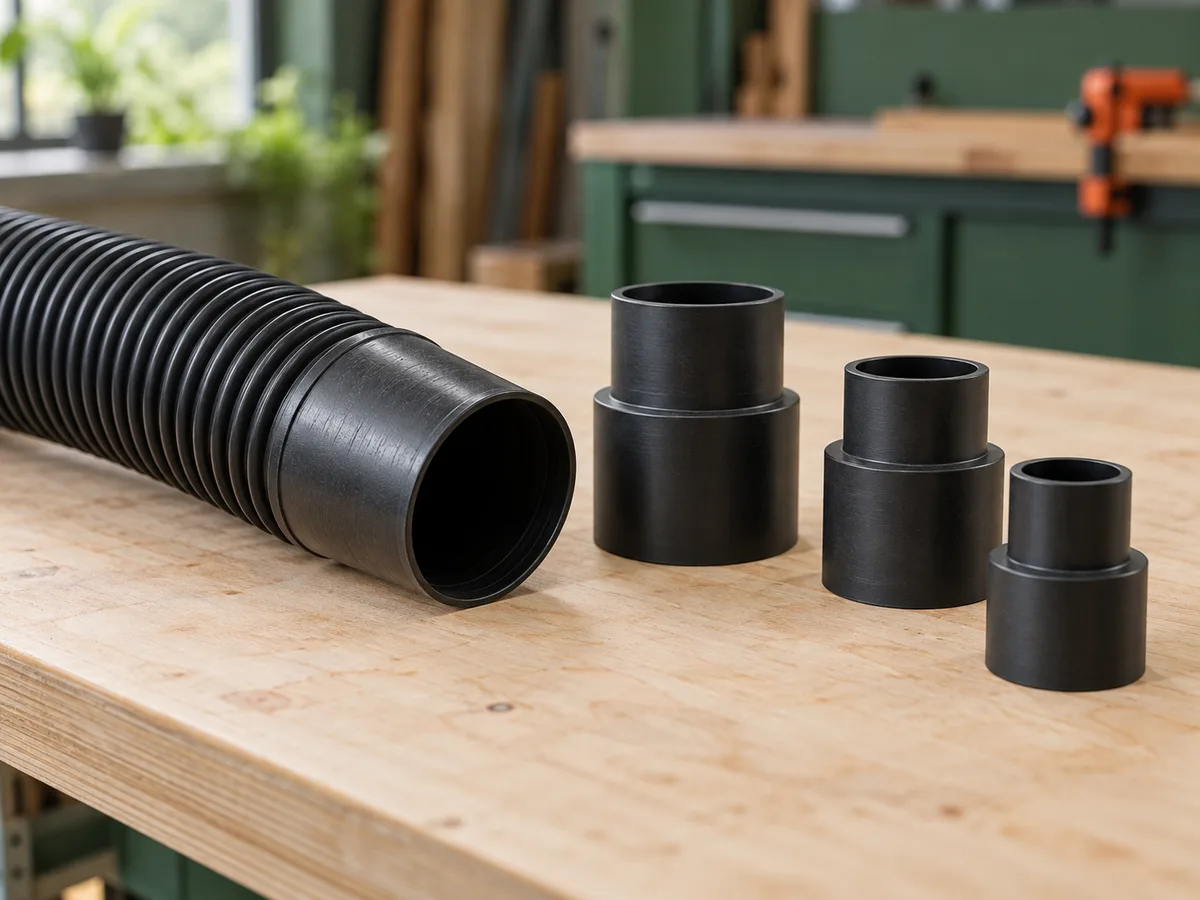
Two fittings described with the same millimetre size may still be incompatible. One dimension may describe a hose bore, another a spigot's outside diameter, and a third a nominal size. Start by writing down exactly what each measurement refers to.
Make a connection sketch
| Item | Record |
|---|---|
| Machine outlet | Model, connection location and inner/outer diameter if specified |
| Hose | Maker's size description, length and permitted type |
| End fitting | Collar, bayonet, taper or other coupling details |
| Adaptor | Both ends, direction of fit and maker compatibility statement |
| Other ports | Any separate guard or second extraction connection |
With the machine isolated as its manual requires, photograph the connection and note the manual page. If the maker gives only a nominal size, preserve that uncertainty. A product photograph is not a reliable dimensional drawing.
Examples of incomplete dimensions
Axminster's AC216TS and AC254TS manual lists 100 mm and 63 mm dust outlets. It does not label those specification entries as inner or outer diameters. Our dataset therefore records them as nominal sizes rather than guessing an interference fit.
Festool describes the supplied CTM MIDI I hose as D 27/32 with a conical shape. That is not a claim that every 27 mm outlet accepts its connector. Check the relevant tool coupling or approved adaptor.
A fitted hose is only one check
An adaptor can solve a connection problem without demonstrating adequate extraction. HSE calls for an appropriate extraction flow rate, antistatic hoses suitable for wood dust and secure connections without obvious leaks. Ask the extraction supplier to confirm the complete arrangement, including any separator, additional hose or changes of diameter.
For an existing system, our suggested record is a simple chain: machine port → adaptor → hose → separator, if used → extractor. Beside each join, write the part number and what still needs confirming. This makes a supplier enquiry much clearer than “will it fit my saw?”
Do not alter guards or obstruct access to safety controls to accommodate a hose. Refer changes to the machine maker. Use the extraction planner to organise dimensions, and the saw extraction guide when a machine has more than one capture point.
Sources & further reading
Checked 2026-10-25. Manufacturer figures are specifications, not independent performance tests.